The first sign may be so small that it barely feels real: a hand tightening around a finger, eyes opening for seconds, a face turning toward a familiar voice. A guide to understanding coma recovery has to begin there, with a difficult truth. These moments can matter, but no single movement can reveal the whole outcome. Recovery from coma is not a switch being flipped. It is a clinical investigation unfolding over days, weeks, or longer.
For families, uncertainty can feel almost unbearable. The person in the bed may look asleep, yet the medical team is tracking details that are easy to miss: breathing patterns, reflexes, brain activity, responses to pain, and whether an action is repeated with purpose. Each finding becomes part of a larger case file. Some answers arrive slowly. Others never become as definite as anyone wants.
What a coma is – and what it is not
A coma is a state of profound unconsciousness. A person does not wake, does not show sustained awareness of themselves or their environment, and cannot reliably follow commands. It can result from traumatic brain injury, stroke, lack of oxygen, infection, seizures, severe metabolic illness, poisoning, or other serious conditions affecting the brain.
Coma is not the same as ordinary sleep, even though sleep-like periods may appear on a monitor or in the room. Nor is it interchangeable with brain death. Brain death is the irreversible loss of all brain function and is legally recognized as death in the United States. A person in a coma is alive, though critically ill, and may retain varying degrees of brain function.
The language can become confusing after the acute phase. Clinicians may use terms such as unresponsive wakefulness syndrome, formerly called a vegetative state, when someone opens their eyes and cycles through sleep and wake periods but shows no clear, repeatable signs of awareness. A minimally conscious state means there is limited but definite evidence of awareness, such as following a simple command on some occasions, visually tracking an object, or making an intentional gesture. Emerging from a minimally conscious state generally means a person can communicate reliably or use objects appropriately.
These are not labels assigned from one dramatic bedside scene. They require repeated assessment. A grimace might be a reflex. A squeeze might be random muscle activity. But a squeeze on command, repeated across exams, changes the evidence.
The first question: is the coma being medically suppressed?
Some patients in intensive care are deeply sedated on purpose. Medications may be used to control dangerous agitation, support mechanical ventilation, manage seizures, or reduce the brain’s demand for oxygen after a serious injury. In these cases, the apparent coma may be partly medication-related.
That distinction matters. Before judging neurological recovery, clinicians may need to reduce sedatives safely, consider how kidney or liver function affects drug clearance, and account for medications that can linger. Severe infection, low body temperature, organ failure, and certain drug exposures can further cloud the examination.
This does not make the situation simple. Sedation can conceal meaningful function, while the injury that required sedation may still be severe. It means the team must separate the effects of illness, treatment, and direct brain injury before making strong predictions.
Guide to understanding coma recovery: what clinicians look for
The most reliable picture comes from trends, not one test or one hopeful afternoon. During serial neurological exams, the team evaluates whether the eyes open, pupils react to light, the person moves spontaneously, and responses appear purposeful. They may ask for a blink, a thumb movement, or a look toward a voice. Consistency is the critical detail.
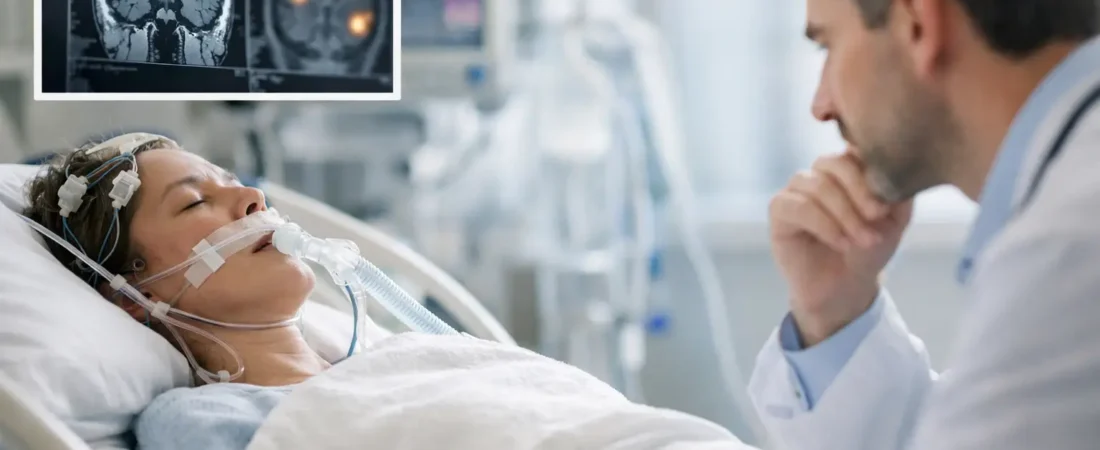
Imaging can reveal structural damage. A CT scan is often used quickly to detect bleeding, swelling, or large strokes. MRI can provide a more detailed map of injured tissue, including patterns associated with trauma or oxygen deprivation. Yet even an MRI is not a crystal ball. A scan can explain why consciousness is impaired without perfectly forecasting an individual’s recovery.
Electroencephalography, or EEG, records electrical activity in the brain. It can detect ongoing seizures that have no visible convulsions, assess background brain activity, and show whether the brain responds to stimulation. Evoked-potential tests may examine how neural pathways respond to sound or touch. Blood tests, oxygen levels, temperature, and the status of other organs matter too. The brain does not recover in isolation.
Clinicians also use structured bedside tools, including the Coma Recovery Scale-Revised, to distinguish reflexive behavior from signs of consciousness. This is more than paperwork. Research has shown that unstructured observations can miss subtle awareness, particularly when patients are fatigued, aphasic, weak, or unable to move reliably.
Why recovery can look uneven
A common image of awakening is cinematic: closed eyes, then a sudden clear sentence. Real recovery is usually stranger and less linear. Early consciousness may be intermittent. A patient may track a loved one with their eyes one morning and show no response later that day. They may emerge confused, agitated, frightened, or unable to form memories of the ICU.
That variability does not automatically mean the earlier response was imagined or that recovery has stopped. Attention, infection, pain, sleep disruption, medication changes, and time of day can all affect performance. A damaged brain may have brief windows of organized function before it can sustain them.
As awareness improves, other deficits may become visible: difficulty speaking, weakness, impulsivity, memory gaps, personality changes, swallowing problems, or a loss of insight into the injury. This can be emotionally jarring. Waking is not always the same as returning to the person everyone remembers. Rehabilitation begins in the middle of that difficult reality.
Prognosis: evidence, uncertainty, and the danger of one deadline
Families often ask the question beneath every other question: Will they come back? Medicine can offer risk estimates, not guarantees. Outcome depends on the cause of coma, the location and extent of brain injury, age and prior health, complications, duration of impaired consciousness, and evidence gathered over time.
Generally, a coma caused by a reversible metabolic problem may carry a different outlook than one following prolonged oxygen deprivation or catastrophic traumatic injury. But broad patterns do not decide an individual case. Timing matters as well. Predictions made too early can be distorted by sedatives, shock, seizures, swelling, or unstable medical conditions.
For that reason, responsible neuroprognostication often uses multiple findings and delayed reassessment rather than a single exam, scan, or number. Ask the care team what is known, what remains uncertain, and when the next meaningful reassessment is expected. Ask whether a specialist in neurology, neurocritical care, or rehabilitation medicine has evaluated the patient. A second opinion can be reasonable when major, irreversible decisions are being considered.
Hope and realism are not opposites. False certainty helps no one, whether it arrives as an overly optimistic promise or a prediction delivered before the evidence is mature.
What families can do at the bedside
Families are not responsible for producing recovery, and they should not blame themselves if progress is slow. Their role can still be significant. A calm, familiar voice and simple orientation can be useful: state your name, where the person is, and the day or time. Avoid treating every visit as a test. Constant demands to wake up can exhaust both patient and family.
Keep a brief record of observable changes, especially actions that seem purposeful and repeatable. Note the time, the exact cue given, and what happened. This can help clinicians see patterns across shifts, though bedside observations should always be interpreted with the team rather than treated as proof on their own.
When speaking with clinicians, direct questions tend to produce clearer answers:
- What condition best describes their level of consciousness right now?
- Could sedation, seizures, infection, or another reversible factor be affecting the exam?
- Which findings are most meaningful, and which are still uncertain?
- What rehabilitation or supportive-care decisions should be discussed now?
Also make room for practical support. Social workers, palliative care teams, chaplains, and rehabilitation specialists can help families navigate decisions, symptoms, communication, and grief. Palliative care is not a declaration that recovery is impossible. It is specialized support for comfort, values, and difficult choices at any stage of serious illness.
Recovery is more than waking
When medically stable, many patients move into rehabilitation focused on mobility, communication, swallowing, attention, memory, and daily tasks. Progress may be measured in small gains: tolerating upright position, using a communication board, recognizing a voice, or completing part of a therapy session. These changes can be medically meaningful even when they do not resemble a complete recovery.
The record may remain incomplete for a long time. A family may find themselves studying a blink, a pause, a glance toward the door, wondering what it means. The most useful approach is neither to dismiss these signs nor to force them into certainty. Bring them to the team, document the pattern, and keep asking the question that moves the case forward: what does the evidence show today?