The monitor goes flat. The room becomes a controlled emergency: compressions, medications, oxygen, shouted times. Then, sometimes, a patient returns with a second account of the event – an account involving a dark passage, a brilliant presence, a panoramic replay of life, or the unnerving certainty of having been somewhere beyond the body. Are near death experiences real? The answer depends on what, exactly, “real” is being asked to mean.
A near-death experience, or NDE, is real in the most basic clinical sense: people report these experiences sincerely, often in vivid and life-altering detail. The harder question is whether the experience reveals consciousness operating apart from a functioning brain, or whether it is a powerful state created by a brain under extreme physiological stress. Medicine has not closed that case file.
What Counts as a Near-Death Experience?
An NDE is not simply a frightening medical event, nor is it a synonym for cardiac arrest. It is a cluster of subjective experiences reported by some people who were close to death or believed they were dying. Reports can occur after cardiac arrest, severe trauma, hemorrhage, complications during surgery, poisoning, childbirth emergencies, and other moments when the body appears to be failing.
Common features recur with surprising consistency. Some people describe peace or separation from pain. Others report traveling through darkness, encountering light, seeing deceased relatives, feeling judged or accepted, or observing medical staff from above. Not every report is serene. A minority are frightening, involving isolation, terror, voids, threatening presences, or a sense of being trapped.
That variation matters. There is no single cinematic script that every patient follows. Culture, belief, personal history, medications, the nature of the illness, and the language available to describe an experience may all shape the final story. Yet similar motifs appear across many accounts, which is one reason the phenomenon continues to attract serious research.
Are Near Death Experiences Real in a Scientific Sense?
If “real” means the person truly had an experience, the available evidence strongly supports that. Dismissing an NDE as a lie, a fantasy, or attention-seeking is neither clinically useful nor consistent with what many survivors describe. The memories may remain extraordinarily vivid for years, sometimes becoming central to a person’s identity, values, relationships, and fear of death.
If “real” means verified evidence that awareness continues after irreversible death, the evidence is not there. Modern resuscitation complicates the language. A patient in cardiac arrest may have no detectable pulse and be unconscious, but they are not necessarily irreversibly dead. CPR can restore circulation, and advanced care can sometimes restart a heart after periods once considered final.
This distinction is more than semantics. The brain does not become a blank screen the instant the heart stops. Blood flow falls sharply, but the timing and degree of brain dysfunction vary. Resuscitation can also produce fluctuating periods of partial circulation. An experience remembered after revival could have formed before the arrest, during the descent into unconsciousness, during CPR, or as the brain recovered.
The central mystery is timing. A patient may feel certain that an event occurred while they were clinically unresponsive. But confidence, even profound confidence, does not by itself establish when a memory was formed.
The Brain Under Extreme Stress
Researchers have proposed several overlapping biological mechanisms. None fully explains every report, and none needs to act alone.
Low oxygen levels, altered carbon dioxide levels, reduced blood flow, and rapidly changing brain chemistry can affect perception, memory, and the sense of self. Certain conditions can produce tunnel vision, bright lights, sensations of floating, distorted time, and dreamlike narratives. Drugs used in emergency and intensive care settings may also contribute to hallucinations, fragmented memories, and delirium.
There is also evidence that the brain can show organized electrical activity around cardiac arrest and during resuscitation. That does not prove conscious thought is occurring, nor does it prove it is absent. Brain activity is not a simple on-off switch, especially during a crisis. The clinical reality is messier: a damaged, oxygen-starved brain may generate intense experience while also failing to create a reliable memory record.
Some scientists compare elements of NDEs to REM sleep intrusion, dissociation, temporal lobe activity, migraine aura, anesthesia awareness, or psychedelic states. These comparisons can be illuminating, but they are not verdicts. A resemblance between two experiences does not establish that they have one cause.
The life review is particularly difficult to reduce to a single mechanism. Memory is not a video archive, and under stress the brain can rapidly assemble fragments into emotionally charged narratives. But that explanation remains a model, not a direct observation of what happened in every individual case.
The Out-of-Body Question
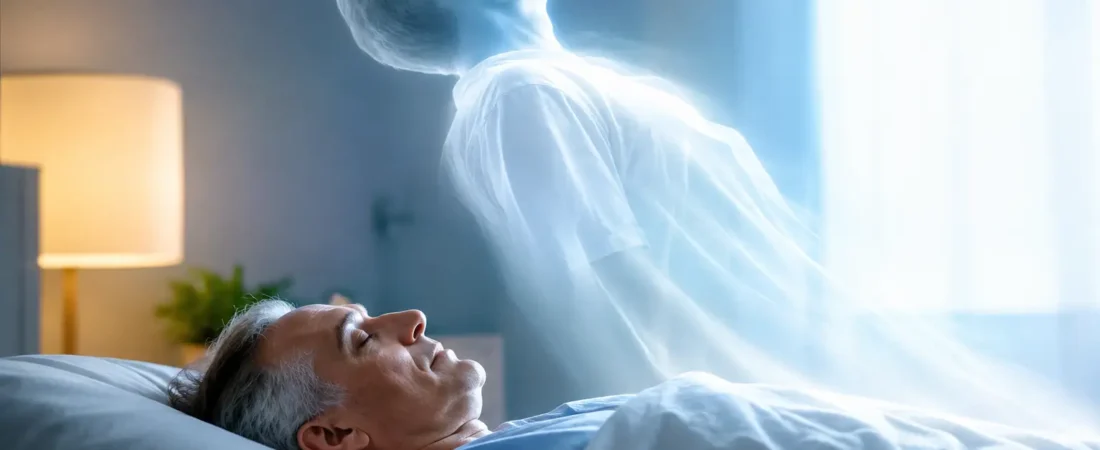
The most contested reports involve apparent perception from outside the body. A patient might describe the position of a defibrillator, a conversation between clinicians, or a detail from the resuscitation room they should not have been able to see or hear.
These cases deserve careful investigation, not automatic acceptance or automatic ridicule. Emergency scenes are noisy. Details can be learned after the event through conversations, inference, staff reactions, or memories formed as consciousness returns. Human memory is also reconstructive. It can preserve a strikingly accurate detail while quietly filling gaps with assumptions.
At the same time, researchers have attempted prospective studies in hospitals using hidden visual or auditory targets that could be identified only from an elevated vantage point. Such studies are difficult to conduct because cardiac arrests are unpredictable, survival rates are limited, and only a fraction of survivors can be interviewed. So far, the results have not provided decisive, repeatable proof that consciousness observed the room independently of the brain.
That lack of proof is not proof that every report is meaningless. It is simply where the evidence currently stands. A compelling story is a reason to investigate further, not a substitute for controlled verification.
Why Accounts Can Feel More Real Than Waking Life
One of the most unsettling details in NDE testimony is the phrase, “It felt more real than real.” That quality can tempt people to treat the experience as self-validating. But intensity is not a laboratory instrument.
Highly emotional states can imprint memories with unusual force. Trauma, dreams, seizures, delirium, and certain drug experiences can all feel absolute while they are occurring. Conversely, ordinary waking memories are often vague and unstable. Vividness alone cannot tell us whether an experience was generated internally or whether it reflected an external reality.
Still, the emotional force should not be trivialized. Many survivors report less fear of death, stronger compassion, altered spiritual beliefs, or difficulty returning to daily life. Others feel isolated because their experience does not fit their previous worldview. A respectful clinician can acknowledge the impact without claiming certainty about its source.
The Most Honest Answer Is Unfinished
Near-death experiences sit at an uncomfortable intersection: subjective testimony, emergency medicine, neuroscience, philosophy, and grief. Science is good at measuring oxygen levels, electrical signals, medications, survival outcomes, and later recall. It is less equipped to settle the metaphysical meaning of a private experience.
The evidence supports several careful conclusions. NDEs are reported by real people after real medical crises. Their features show recognizable patterns but are not identical across patients or cultures. Brain-based explanations are plausible and supported by what is known about altered consciousness, yet no single mechanism explains every detail. Claims that NDEs conclusively prove an afterlife go beyond current evidence. Claims that they are merely nonsense also fail to meet the human and scientific complexity of the phenomenon.
For someone who has had an NDE, the next step does not have to be a verdict. It may be a conversation with a trusted clinician, therapist, spiritual counselor, or support community, especially if the memories are distressing or disruptive. The experience can be taken seriously without forcing it into a conclusion medicine has not earned. Some files remain open not because the evidence is empty, but because the question is larger than the instruments currently available to examine it.