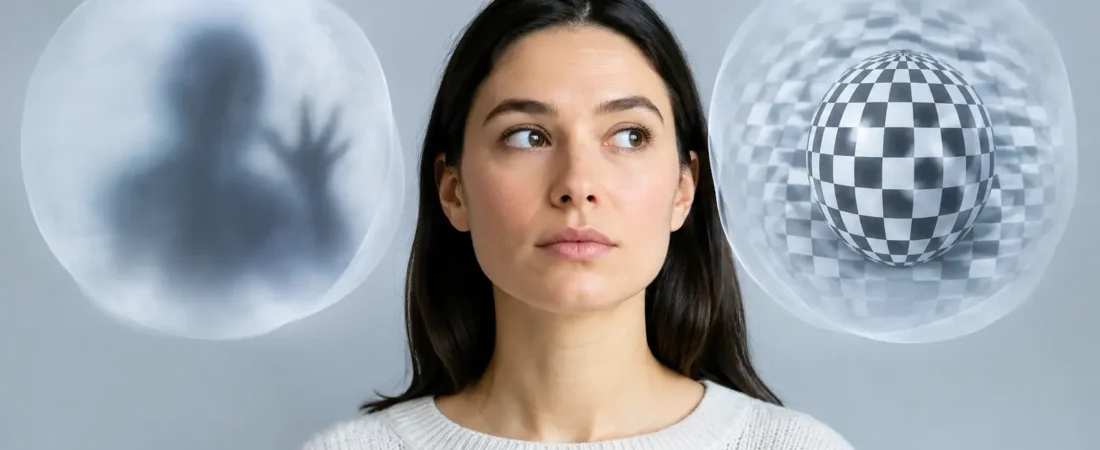
A patient hears someone calling their name from an empty hallway. Another sees a coat on a chair and, for one sharp second, believes it is a person standing watch. Both experiences can feel intensely real. But in the clinical record, hallucinations versus illusions are not interchangeable. One begins without an external stimulus. The other begins with something real, then the brain gets the interpretation wrong.
That distinction is more than medical vocabulary. It can change the questions a clinician asks, the tests they order, and the urgency of the situation. The mind is not a passive camera. It is an active interpreter, constantly turning incomplete sensory data into a version of reality that usually keeps us safe. Usually.
Hallucinations Versus Illusions: The Central Difference
An illusion is a misperception of something that is actually present. The sensory input exists, but the brain identifies it incorrectly. A shadow can become a figure in the room. Running water can sound like distant voices. In dim light, a curtain moving near a window may seem like an animal or intruder.
A hallucination occurs when someone perceives something without a matching external stimulus. A person may hear speech when no sound is present, see a person who is not there, smell smoke in a smoke-free room, or feel movement on the skin without a physical cause. The experience is not pretend, attention-seeking, or necessarily evidence of a psychiatric condition. To the person having it, the perception can be as immediate as a knock at the door.
The difference sounds clean on paper. At a bedside, it may not be. A patient who sees a shape in a dark room may be describing an illusion, a hallucination, a dream-related event, a vision problem, medication effects, or a delirious brain struggling to assemble reality. The investigation starts with the scene.
The question clinicians ask first
What was actually there?
If there was a real object, sound, smell, or sensation that was misidentified, an illusion becomes more likely. If no external source can be found, a hallucination moves higher on the list. But context matters. Lighting, fatigue, fever, isolation, grief, sleep loss, sensory impairment, substance use, and recent medication changes can all alter perception.
A person with severe hearing loss, for example, may mistake vague environmental sounds for words. Someone with poor vision may misread patterns in low light. These are not trivial errors. When the brain receives degraded information, it often fills the gaps with its best available guess. In an unfamiliar hospital room at 3 a.m., those guesses can become disturbing.
Why the Brain Can Misread What It Sees
Perception is part sensory signal and part prediction. The eyes, ears, skin, and nose deliver fragments. The brain compares those fragments with memory, expectation, threat detection, and context, then creates a fast interpretation. This is efficient. It is also vulnerable to error.
Illusions are especially likely when information is ambiguous. Darkness removes detail. Background noise blurs speech. Stress makes neutral shapes feel suspicious. A frightened person walking through a quiet house is more likely to interpret a creak as footsteps than someone calmly hearing the same sound in daylight.
This does not mean every illusion is meaningless or every hallucination signals disease. Healthy people can experience brief perceptual distortions when exhausted, under intense stress, or waking from sleep. The clinical concern rises when experiences are new, persistent, escalating, dangerous, or accompanied by confusion, major behavior changes, neurological symptoms, or impaired functioning.
Hallucinations Are Not One Single Symptom
Hallucinations are often reduced to hearing voices, but perception can take several forms. Auditory hallucinations involve sound, including voices, music, knocking, or whispers. Visual hallucinations can range from flashes and shapes to fully formed people or scenes. Olfactory hallucinations involve smells, often described as burning, chemical odors, or decay. Tactile hallucinations may feel like crawling, tingling, pressure, or touch.
The type of hallucination can provide clues, though it cannot diagnose a cause by itself. Vivid visual hallucinations in an older adult with fluctuating attention may raise concern for delirium, medication effects, a neurocognitive disorder, or neurological illness. Hallucinations around falling asleep or waking can occur in otherwise healthy people and are known as hypnagogic or hypnopompic hallucinations. Hearing voices may occur in psychotic disorders, but also in mood disorders, trauma-related conditions, severe sleep deprivation, substance use, and certain medical illnesses.
The case file rarely offers one neat answer. A clinician considers the person’s age, medical history, timing, sleep, medications, substance exposure, mood, cognition, and physical exam. The question is not simply, “Do you hear voices?” It is, “When did this begin, what else changed, and what might the nervous system be trying to tell us?”
When the Pattern Points to a Medical Cause
A sudden hallucination in someone who has never had one deserves attention, particularly when it arrives with confusion. Delirium can develop rapidly due to infection, dehydration, low oxygen, metabolic problems, medication reactions, withdrawal, surgery, or many other medical triggers. In delirium, attention often drifts. The person may be disoriented, agitated, unusually drowsy, or sharply different from their usual self.
Fever and infection can produce vivid illusions or hallucinations, especially in children and older adults. So can sleep deprivation. After enough missed sleep, the boundary between perception, dream imagery, and thought can become unstable. Substance intoxication or withdrawal can also produce frightening distortions, from moving shadows to voices or tactile sensations.
Some neurological conditions may be involved as well. Migraine aura can cause visual phenomena. Seizure activity can occasionally create unusual smells, tastes, sensations, or visual experiences. Parkinson’s disease and some forms of dementia can involve hallucinations, sometimes worsened by medications. Serious vision loss may be associated with Charles Bonnet syndrome, in which a person experiences visual hallucinations while otherwise recognizing that the images are not real.
None of these possibilities should be self-diagnosed from a symptom list. They illustrate why dismissing a person as “just imagining things” can be medically dangerous. The perception may be unreal, but the need for care can be very real.
The Details That Change the Investigation
When someone reports a strange perception, the response matters. A calm, specific description is more useful than an argument about whether it happened. Clinicians often want to know whether the person recognizes the experience as unusual, how long it lasts, whether it occurs at a particular time, and whether it creates a risk of harm.
They may also ask about recent illness, head injury, new prescriptions, dose changes, alcohol or drug use, sleep, vision, hearing, and stress. A medication list can be particularly revealing. Some medications can contribute to confusion or hallucinations, especially in combination or at higher doses. That does not mean a person should stop prescribed medication abruptly. Sudden changes can create their own dangers.
There is another detail that deserves care: emotional meaning. A grieving person may briefly hear the familiar voice of someone who died. Someone with trauma may misinterpret a sound that resembles a past threat. These experiences can be deeply unsettling, but they should be approached with compassion rather than automatic assumptions. Medicine must investigate without humiliating the person living through the symptom.
When to Treat It as Urgent
A new hallucination or severe perceptual change warrants prompt medical evaluation when it appears suddenly, follows a head injury, occurs with fever, confusion, fainting, severe headache, weakness, speech changes, seizures, or trouble breathing. Urgent help is also needed if the person may harm themselves or someone else, cannot care for themselves safely, or is acting on commands they hear.
In the United States, call 911 or seek emergency care for immediate danger, severe confusion, or possible stroke symptoms. If someone is experiencing a mental health crisis or thoughts of self-harm, call or text 988 for the Suicide & Crisis Lifeline. Stay with the person if it is safe to do so, reduce stimulation, avoid confrontation, and do not reinforce frightening beliefs as fact.
For less urgent but persistent symptoms, a primary care clinician, psychiatrist, neurologist, or other appropriate professional can help trace the source. The right path depends on the pattern. A hallucination after three sleepless nights is a different case from recurring visual images in a person with vision loss, and different again from abrupt confusion in a patient with a fever.
The unsettling part is that perception can fail with absolute conviction. A shadow can become a stranger. Silence can become a voice. But the task is not to decide whether someone is “crazy” or to force a quick explanation. It is to examine the evidence carefully, protect the person experiencing it, and keep asking what changed before the signal turned strange.