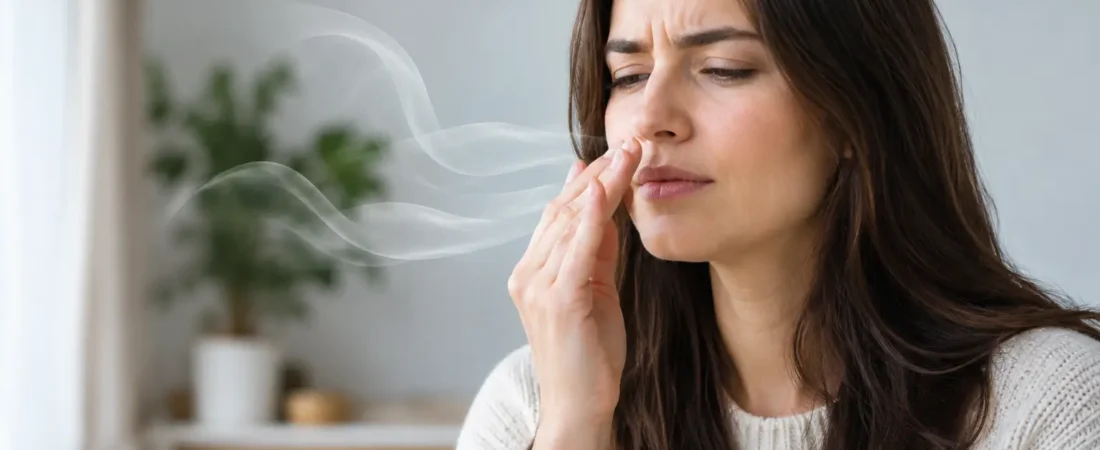
A smell arrives with no visible source: cigarette smoke in a clean room, burning rubber while driving, something metallic and rotten at the edge of every breath. You ask whether anyone else notices it. They do not. Phantom smell causes can be ordinary, temporary, and treatable. They can also be the first clue in a neurological or medical investigation that should not be postponed.
The clinical term is phantosmia – a type of smell disorder in which a person perceives an odor that is not present. It is not a supernatural warning, a failure of hygiene, or proof that someone is imagining things. It is a sensory signal without a matching chemical source in the air. The question is where that false signal began.
The first question: is it really phantosmia?
Smell disorders can look similar from the inside, but the distinction changes the case.
Phantosmia is an odor perception without an external odor. Parosmia is different: a real smell is present, but the brain interprets it incorrectly. Coffee may suddenly smell like sewage; meat may smell chemical or burned. Hyposmia is reduced smell, while anosmia is a near-total or complete loss of smell.
That distinction matters because a person recovering from a respiratory infection may notice parosmia when food smells wrong. Someone repeatedly smelling smoke in an odorless room may be describing phantosmia. Both can be disruptive, but they do not necessarily point to the same mechanism.
Phantom odors are often unpleasant. Smoke, burning plastic, gasoline, rotten food, chemicals, sewage, and metallic smells appear frequently in patient descriptions. Yet the character of the odor does not diagnose the cause. A burning smell can occur with sinus disease, migraine, seizure activity, or no clear explanation at all.
Phantom smell causes often begin in the nose
The smell pathway is unusually exposed. Odor molecules enter through the nose and meet specialized sensory cells high in the nasal cavity. From there, information travels through the olfactory nerve and into brain regions involved in smell, memory, and emotion. Trouble can arise at either end of that route.
Nasal and sinus inflammation is one of the more common explanations. A cold, allergies, chronic sinusitis, nasal polyps, or other irritation can alter how odor signals are received. In some cases, inflammation or blockage causes a distorted smell; in others, it may contribute to phantom sensations.
Viral illness is another major part of the case file. COVID-19 brought public attention to smell loss and smell distortion, but many respiratory viruses can affect the olfactory system. Recovery is unpredictable. Some people regain normal smell within weeks. Others experience distorted or phantom odors for months as the system repairs itself and the brain recalibrates incoming signals.
Head injury deserves equal attention. Even a concussion can affect smell if the force damages delicate olfactory nerve fibers or the brain areas that process odor. A new smell disturbance after a fall, sports injury, vehicle crash, or assault should be discussed with a clinician, especially if it comes with persistent headache, confusion, vomiting, weakness, or changes in vision.
Dental problems, dry nasal passages, exposure to smoke or chemical irritants, and certain medications may also play a role. The timing can be revealing. Did the odor begin after an infection? After starting a medication? Only during allergy season? A symptom diary can turn an eerie, vague experience into useful evidence.
When the signal may come from the brain
Not every phantom odor begins in the nasal cavity. Smell is processed by a network of brain structures, including areas of the temporal lobe. When that network misfires, the result can be an odor that feels startlingly real.
For some people, phantosmia occurs as part of a migraine aura. The smell may appear before or during a headache, though unusual sensory symptoms should not automatically be labeled migraine without medical assessment. Patterns matter: recurrent episodes with similar timing, light sensitivity, nausea, visual disturbances, or a familiar headache pattern may support that possibility.
Focal seizures, particularly those involving the temporal lobe, can sometimes begin with an olfactory aura. The person may smell something burning, foul, or unfamiliar for seconds or minutes before other symptoms develop. Those symptoms can include a sudden wave of fear, déjà vu, a rising sensation in the stomach, staring spells, lip-smacking, confusion, or a period of lost awareness. Many phantom smell episodes are not seizures, but a brief, repeated odor followed by altered awareness is a detail that warrants prompt neurological evaluation.
Less commonly, smell changes may occur with neurodegenerative conditions such as Parkinson’s disease or Alzheimer’s disease. Loss of smell is more classically discussed than phantom odors, and phantosmia alone does not diagnose either condition. Still, clinicians consider the broader neurological picture when smell changes occur alongside tremor, movement changes, memory problems, or shifts in behavior.
Brain tumors are often the feared explanation, but they are not the most likely one. They are also not something an article can rule out. A persistent new phantom smell, particularly with worsening headaches, seizures, personality changes, visual symptoms, or focal weakness, should be evaluated rather than watched indefinitely.
The clues a clinician will want
The investigation usually starts with a history, not a dramatic scan. A clinician may ask whether the smell affects one nostril or both, how long each episode lasts, whether it is constant, and whether anyone else can detect an actual odor. They will ask about recent infections, allergies, sinus symptoms, injuries, medications, migraine history, seizure-like symptoms, smoking, and workplace exposures.
An ear, nose, and throat specialist may examine the nasal passages, sometimes using a small camera to look for inflammation, polyps, infection, or structural issues. Depending on the story, smell testing, imaging, or referral to neurology may follow. Imaging is not necessary for every case. It becomes more relevant when symptoms are persistent, unexplained, one-sided, associated with neurological signs, or concerning on examination.
Do not try to diagnose the source based on the smell alone. The brain’s description is vivid, but it is not a lab result. A smoke smell does not automatically mean seizure activity, and a rotten smell does not prove a sinus infection.
When to treat it as urgent
Some circumstances move this symptom out of the curious category and into urgent care. Seek emergency help if a phantom smell begins suddenly with signs of stroke, including face drooping, weakness or numbness on one side, trouble speaking, severe imbalance, new confusion, or a sudden severe headache.
Urgent assessment is also appropriate after a significant head injury, after a seizure or episode of lost awareness, or when phantom odors occur with severe headache, fever and neck stiffness, major behavior change, or new vision problems. If you suspect there may be a real gas leak, electrical fire, or chemical exposure, leave the area and follow local safety guidance before assuming the smell is phantom.
For a non-emergency but persistent symptom, make an appointment if the odor lasts more than a few days, keeps returning, disrupts eating or sleep, or follows an infection or head injury. The goal is not to catastrophize. It is to document a signal that the body has repeated often enough to deserve an explanation.
Can phantom smells be treated?
Treatment depends on the suspected cause. Addressing allergies, sinus inflammation, infection, nasal polyps, migraines, or medication effects may reduce symptoms. When smell dysfunction follows a viral illness, some clinicians recommend olfactory training: regularly and deliberately smelling a small set of distinct scents over time to support recovery. Results vary, and improvement can be slow.
If testing does not reveal a dangerous cause, that does not make the experience trivial. Constant unpleasant odors can interfere with appetite, sleep, work, and mood. They can make familiar rooms feel contaminated and ordinary meals feel unsafe. Discussing the practical impact is part of the medical history, not an afterthought.
Keep a brief record: the odor, date and duration, what happened just before it started, other symptoms, recent illnesses, and new medicines or exposures. Bring that record to the appointment. In a case built from subtle details, the timeline is often the first real piece of evidence.
A phantom smell is not always a warning of something severe. Sometimes it is the aftermath of inflammation, infection, or an injured sensory system finding its way back. But when the signal repeats, changes, or arrives with neurological symptoms, do not let its invisible nature make it easy to dismiss. The source may be hidden. The evidence does not have to be.