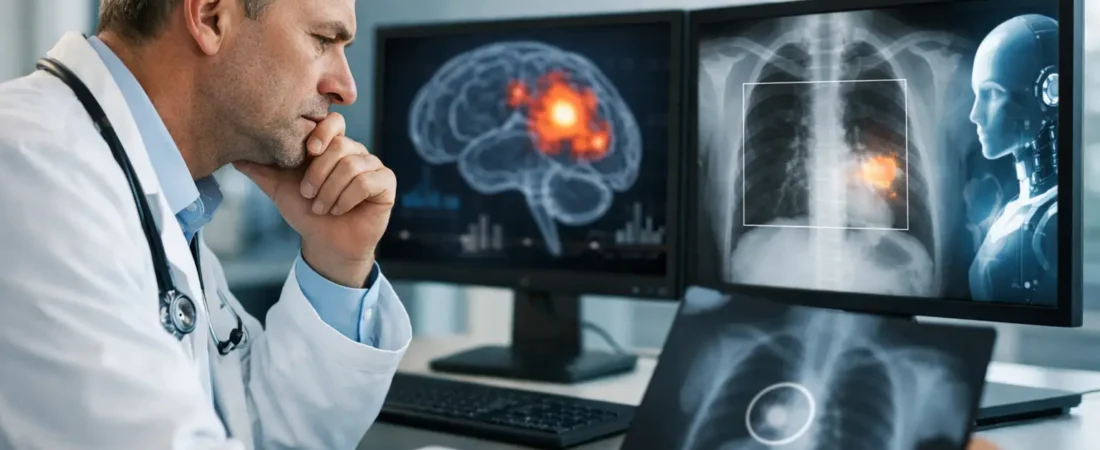
The image looks ordinary until someone points to a shadow no human eye had flagged. A diagnostic AI system has marked it with a bright outline and a probability score. In seconds, the case changes shape: perhaps there is a tumor, a fracture, a hemorrhage, a disease hiding in plain sight. Or perhaps the machine has found a pattern that was never there.
That uncertainty is the real story. Diagnostic AI is often presented as a tireless second set of eyes, and in some settings it can be exactly that. But medicine is not a clean stream of data. It is a room full of incomplete histories, imperfect images, anxious people, subtle symptoms, and consequences that do not fit neatly inside an algorithm’s output.
The Case File: What Diagnostic AI Actually Does
Diagnostic AI refers to software that analyzes medical information to help identify disease, assess risk, prioritize urgent cases, or support clinical decisions. The data may come from X-rays, CT scans, pathology slides, electrocardiograms, retinal photographs, lab results, electronic health records, or even recordings of a cough or voice.
Most systems do not “know” disease in the human sense. They detect statistical relationships learned from large collections of labeled examples. Show a model enough chest images marked as pneumonia, for example, and it may learn visual features associated with those labels. Give it records from patients who later developed sepsis, and it may learn combinations of vital signs and lab changes that often appeared before that diagnosis.
The result is usually not a verdict. It is a signal: suspicious, low risk, needs review, likely abnormal. That distinction matters. A probability can be clinically useful without being clinically complete.
In radiology, AI may help triage scans with possible strokes or collapsed lungs so they reach a specialist sooner. In pathology, it may flag tiny areas on a digital slide that deserve a closer look. In ophthalmology, some systems can identify signs of diabetic retinopathy from retinal images. These are not small achievements. Earlier review can mean earlier treatment.
But the most compelling demonstrations often occur under controlled conditions. The harder question begins after the software leaves the lab and enters a crowded emergency department at 2:00 a.m.
Why a Good Prediction Can Still Be a Bad Diagnosis
A diagnostic system can be highly accurate and still fail the patient in front of it. Accuracy is an average. Medicine happens one case at a time.
Consider a tool trained mostly on high-quality images from one set of hospitals. It may perform well when the scanner, patient population, image technique, and clinical workflow resemble its training environment. Move it to a rural clinic, a pediatric unit, or a hospital serving a different demographic group, and its behavior may shift. An image artifact, an uncommon implant, or a disease presentation rarely seen in training can become a blind spot.
There is also the problem of prevalence. If a condition is rare, even a test with impressive sensitivity and specificity can generate false alarms. A positive flag may feel ominous, especially when it arrives with a polished confidence score, but its real meaning depends on the patient’s symptoms, history, exam, and how common the suspected disease is in that setting.
Then there are the cases that refuse to resemble the dataset. The patient with vague fatigue, intermittent fever, and a rash that appears only in photographs. The person whose medication change altered a lab value in an unexpected direction. The child whose scan looks normal but whose parents describe a frightening regression at home. These clues can be decisive, and they are often scattered across time, conversation, and human observation.
An algorithm can process astonishing amounts of information. It may still miss the one detail nobody thought to digitize.
The danger of automation bias
Machines do not need to be correct to influence a decision. They only need to appear authoritative.
Automation bias occurs when clinicians give an automated recommendation more weight than it deserves, particularly under time pressure or fatigue. The opposite can happen too: a clinician may dismiss a valid alert after encountering repeated false positives. Neither reaction is irrational. Both are predictable responses to a tool that sometimes helps and sometimes interrupts.
The safest role for AI is often not replacement, but friction. A well-designed system should prompt a clinician to look again, explain why it is concerned when possible, and fit into a process where disagreement is allowed. If a physician cannot question the output, verify the evidence, or understand the system’s limits, the tool has become less like a colleague and more like an unexplained command.
The Missing Evidence Behind the Screen
Every medical record contains absences. A patient may not mention a symptom because they are embarrassed. A clinician may document it in a note that the system cannot interpret well. A prior scan may be unavailable. The diagnosis may depend on whether a tremor began before or after a medication, whether a headache wakes someone from sleep, or whether a family member noticed a change in personality weeks ago.
These details are not noise. They are often the plot.
AI systems can also inherit the imperfections of the systems that produced their training data. A diagnosis code is not always a confirmed diagnosis. A clinical note may reflect uncertainty. Access to follow-up care differs between communities, which can distort the records used to define outcomes. If some populations were underrepresented, misdiagnosed, or less likely to receive definitive testing, the historical record may carry those gaps forward.
This is why bias in diagnostic AI is not merely a technical concern. It is a patient-safety concern. A model that performs less well for certain skin tones, ages, sexes, disability groups, or care settings can amplify an old problem with the speed and scale of software.
Independent testing matters because a vendor’s performance claim is only one piece of evidence. Clinicians and health systems need to ask where the system was trained, which patients were included, what outcome it predicts, how often it misses disease, and how its performance changes in their own environment. A tool should be monitored after deployment, not treated as finished because it passed an initial evaluation.
Diagnostic AI Is Most Useful When It Knows Its Place
The strongest applications tend to be narrow, specific, and connected to a clear clinical action. A program that identifies possible intracranial bleeding on a CT scan can help move a scan up the review queue. A model that flags a suspicious lesion can ensure it receives attention. A system that detects a concerning trend in vital signs can prompt an earlier bedside assessment.
The key word is prompt. The software should make the next human action more informed, not make the human unnecessary.
That means good implementation is as important as clever code. Who receives the alert? How quickly can they respond? What happens if they disagree? Is the tool adding useful attention or burying the team in alarms? Does it worsen disparities by working best only for the patients most represented in its data? These are operational questions, but they determine whether a prediction becomes help or harm.
Patients also deserve clarity. If AI contributed to an assessment, the conversation should not become a theatrical mystery involving a black box. People need to know that the final diagnosis remains a clinical judgment shaped by evidence, uncertainty, and their individual circumstances. They should also know that an AI result, positive or negative, is not a substitute for seeking care when symptoms are urgent or worsening.
The Question That Remains
There is something almost irresistible about the idea of a machine that sees what we cannot. Medicine has always searched for a better instrument: the stethoscope, the X-ray, the microscope, the scan. Diagnostic AI belongs in that lineage, but it is not simply another lens. It makes inferences, prioritizes possibilities, and can quietly steer attention.
Used carefully, it may catch patterns before they become disasters. Used carelessly, it can create a new kind of missed diagnosis: one hidden behind a reassuring score, a highlighted image, or the assumption that the computer must have seen everything.
The most reliable safeguard is not fear of the technology or blind faith in it. It is disciplined investigation. Ask what the system saw, what it could not see, whose data taught it, and whether the patient’s story still fits. The chart may contain an answer. The scan may contain a clue. But the unanswered question is often where the real case begins.