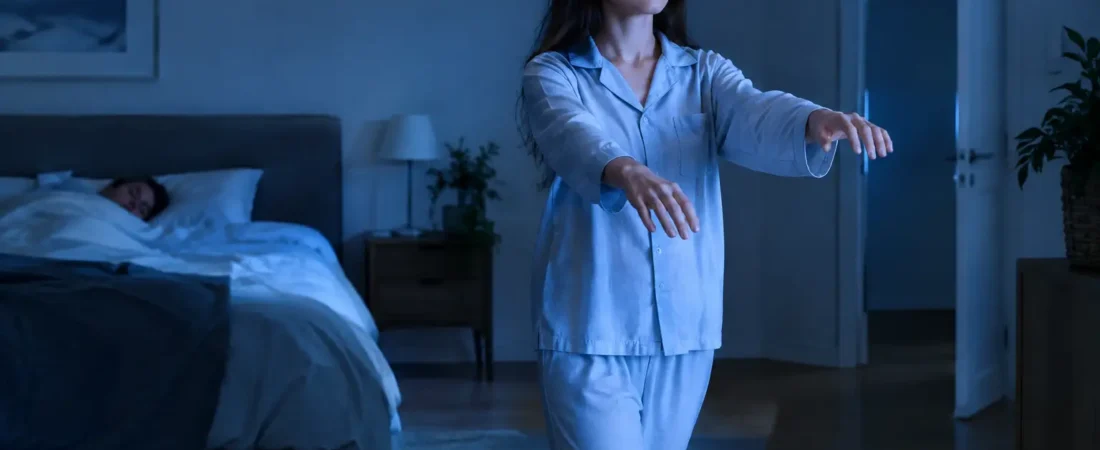
A bedroom door opens at 2:13 a.m. Someone walks down a dark hallway, answers a question with nonsense, or begins searching through a drawer. Their eyes may be open. Their face may look blank. By morning, there may be no memory at all. Why do people sleepwalk? The answer begins with a disturbing fact: part of the brain can be awake enough to move while the systems responsible for judgment, awareness, and memory remain deeply asleep.
Sleepwalking is not usually a person acting out a dream. It is a partial awakening from a particular stage of sleep, one that leaves the body in motion while consciousness has not fully returned. The result can look uncanny because it is a genuine mismatch inside the nervous system.
Why Do People Sleepwalk During Deep Sleep?
Sleepwalking, clinically called somnambulism, belongs to a group of conditions known as disorders of arousal. These events usually emerge from deep non-REM sleep, especially slow-wave sleep, rather than from rapid eye movement, or REM, sleep. Deep non-REM sleep is most concentrated in the first third of the night, which is why many episodes occur relatively soon after someone falls asleep.
During a normal awakening, brain networks come online in sequence. Awareness returns. The sleeper recognizes the room, understands a question, and can form a memory of what happened. During a sleepwalking episode, that transition appears incomplete. Motor systems may activate enough for sitting up, walking, eating, or performing familiar routines. Meanwhile, areas involved in clear decision-making and self-awareness remain impaired.
That is why a sleepwalker may navigate a familiar home yet appear confused when interrupted. They are not usually pretending, possessed, or secretly revealing hidden intentions. They are caught in an unstable state between sleep and wakefulness.
The details vary. Some people simply sit upright and stare. Others mumble, move objects, or head toward a bathroom. A smaller number may leave the house, attempt to cook, drive, or become injured. Those more dramatic events are uncommon, but they are the reason sleepwalking deserves more than a joke about midnight wandering.
The Triggers Hidden in the Case File
Sleepwalking is especially common in children, whose brains spend more time in deep slow-wave sleep. Many children outgrow it as their sleep architecture changes with age. In adults, episodes can still occur, but new or frequent sleepwalking should prompt a closer look at the surrounding evidence.
There is often a family pattern. A person with close relatives who sleepwalked may be more likely to experience it, suggesting a genetic contribution. But heredity is not the whole explanation. An inherited tendency may remain quiet until something repeatedly disrupts deep sleep.
Sleep deprivation is a common trigger. When someone has been chronically short on sleep, the brain may rebound with more intense deep sleep, creating conditions that make partial arousals more likely. Irregular schedules, jet lag, night shifts, fever, and emotional stress can also fragment sleep at exactly the wrong moment.
Other sleep disorders can contribute. Obstructive sleep apnea, for example, repeatedly interrupts breathing and can cause abrupt arousals throughout the night. Restless legs syndrome and periodic limb movements may do something similar. In these cases, the sleepwalking may be less a standalone mystery than a signal that sleep itself is being repeatedly disturbed.
Certain medications and substances can matter too. Sedatives, some sleep medications, psychiatric medications, and alcohol may alter sleep stages or increase confusion during nighttime awakenings. The relationship is not identical for every drug or every patient. A medication should never be stopped abruptly based on a frightening night alone, but a prescriber should know if episodes begin after a new medication or dose change.
What Sleepwalking Is Not
The imagery of sleepwalking has invited myths for centuries. One of the most persistent is that waking a sleepwalker is dangerous. It is not known to be physically dangerous in the dramatic way folklore suggests. But waking someone suddenly can leave them frightened, disoriented, or defensive, particularly if they are in motion or do not recognize where they are.
The safer approach is usually quiet redirection. Speak calmly, use minimal physical contact if possible, and guide the person back toward bed. If they are moving toward stairs, glass, traffic, weapons, or another immediate hazard, safety takes priority. Do not corner them, shake them, or turn the moment into an interrogation.
Sleepwalking is also different from REM sleep behavior disorder. In REM sleep behavior disorder, a person may physically act out vivid dreams because the normal muscle paralysis of REM sleep is reduced or absent. These episodes often occur later in the night, and the person may recall a detailed dream. Sleepwalking more often arises from deep non-REM sleep, with little or no memory afterward.
The distinction matters because similar-looking nighttime behavior can have very different causes. A clinician may need to separate sleepwalking from nocturnal seizures, panic episodes, medication effects, REM sleep behavior disorder, or other parasomnias. The bedroom is not always a reliable witness.
When an Unusual Episode Needs Medical Attention
An occasional, uncomplicated episode in a child may not require extensive testing. A pattern of escalating events is different. Adult-onset sleepwalking, frequent episodes, injuries, dangerous behavior, loud snoring with pauses in breathing, extreme daytime sleepiness, or movements that look violent or seizure-like all warrant medical evaluation.
A sleep specialist may ask for a detailed history from both the sleeper and anyone who has witnessed the episodes. Timing matters. So do medication changes, alcohol use, stress, work schedules, snoring, and family history. A sleep diary can reveal patterns that memory misses.
In some cases, overnight sleep testing is useful, especially when another sleep disorder is suspected or the events are atypical. A test may not capture an episode on a single night, but it can identify disrupted breathing, unusual movements, and other clues. The goal is not merely to attach a label. It is to identify what is destabilizing sleep and reduce the risk that follows.
Making the Night Safer
The immediate objective is prevention, not punishment. Sleepwalkers do not need blame or embarrassment. They need a safer environment and a more stable sleep schedule.
For recurring episodes, practical safeguards can make a real difference:
- Keep doors and windows secured, especially if the person has tried to leave the home.
- Clear floors, stairs, and routes to the bathroom of clutter, cords, and sharp objects.
- Store car keys, medications, firearms, and other high-risk items out of reach.
- Use gates or alarms when wandering creates a meaningful fall or exit risk.
A consistent bedtime, adequate sleep, and treatment for conditions such as sleep apnea may reduce episodes for many people. Managing stress can help, but it should not be presented as a simple cure. Sleepwalking is not proof that someone is failing to cope. It is a physiological event shaped by sleep depth, arousal, vulnerability, and sometimes an underlying medical issue.
For children with predictable episodes, some clinicians may suggest scheduled awakenings. This involves gently waking the child shortly before the usual event time for a brief period, then allowing them to return to sleep. It is a targeted strategy, not a universal fix, and it works best when episodes happen at a reliably similar time.
The Unsettling Divide Between Motion and Memory
What makes sleepwalking so eerie is not simply that a person walks while asleep. It is the apparent disappearance of the person we expect to find behind their eyes. Familiar actions continue. A body moves through a known space. Yet the capacity to understand, choose, and later remember may be absent.
Sleep medicine offers a grounded explanation, but not a trivial one. Consciousness is not a switch that flips cleanly from off to on. It is a layered process, and sleepwalking exposes what can happen when those layers awaken out of order.
If someone in your home sleepwalks, treat the event like a safety issue rather than a spectacle. Observe the timing, protect the environment, and bring a clinician the details that daylight can easily erase. The night may be strange, but the investigation can still lead somewhere useful.