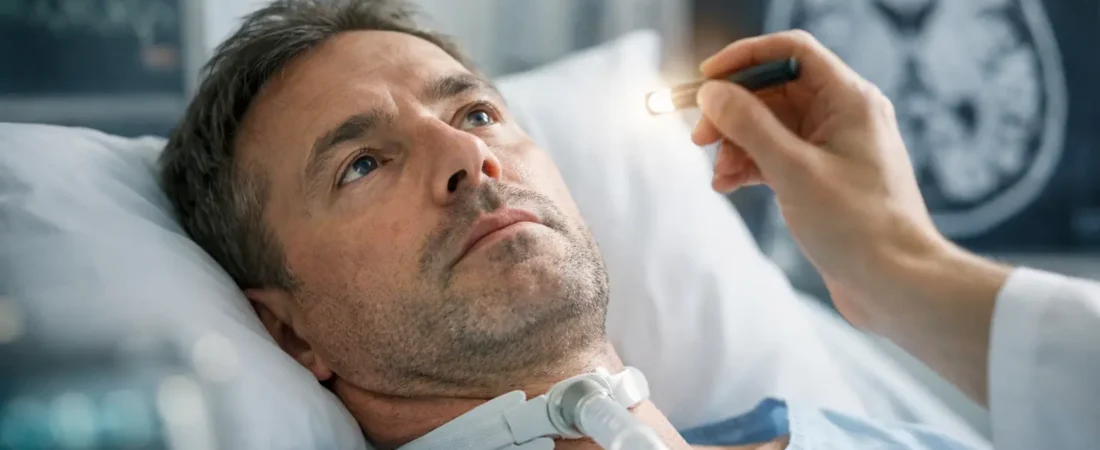
A patient lies motionless in an intensive care bed. No speech. No movement that staff can reliably see. The first impression may be coma, severe brain injury, or a consciousness that has disappeared. But locked in syndrome cases force a far more disturbing possibility into the room: the person may be awake, aware, and listening.
This is not a fictional premise or a medical trick. Locked-in syndrome is a rare neurological condition in which a person retains consciousness but loses nearly all voluntary movement and speech. The body becomes almost inaccessible. The mind does not necessarily follow.
The neurological trap behind locked in syndrome cases
Locked-in syndrome usually occurs after damage to the ventral pons, a part of the brainstem that carries motor signals from the brain to the body. A stroke caused by blockage of the basilar artery is the classic cause. Severe trauma, bleeding, tumors, infection, and certain demyelinating disorders can also damage the same critical pathways.
The injury interrupts commands for movement without necessarily destroying the brain regions that sustain alertness, memory, sensation, and thought. The result can look deceptively simple from outside: paralysis. Inside, it may be anything but simple.
Most people with the condition cannot move their limbs, face, or mouth enough to speak. They may be unable to breathe independently at first. Yet vertical eye movement and blinking are often preserved because these functions travel through different pathways. A blink can become a signal. Looking up can mean yes; looking down can mean no. In the most severe presentations, even this narrow channel may be lost.
That distinction matters because locked-in syndrome is not the same as coma. A person in a coma is unarousable and shows no conscious awareness. A person in an unresponsive wakefulness syndrome may open their eyes and cycle through sleep and wake states without clear evidence of conscious interaction. In locked-in syndrome, awareness is present, but the ability to demonstrate it is profoundly limited.
The three forms clinicians look for
Medical literature commonly describes three forms. In classic locked-in syndrome, consciousness and vertical eye movements or blinking remain intact, while speech and limb movement are absent. In incomplete locked-in syndrome, small additional movements survive, perhaps a finger twitch, head turn, or limited facial motion. In total locked-in syndrome, no reliable voluntary movement can be observed, including eye movement.
The categories are clinically useful, but real cases can shift over time. Swelling may obscure residual movement in the acute stage. Sedating medications, delirium, infection, fatigue, hearing loss, and eye injury can further complicate an examination. A response that vanishes one day may return under different conditions the next.
This is why a single bedside assessment should not be treated as a final verdict. The central question is not merely, “Can the patient move?” It is, “Have we created a fair enough test for this patient to show us what they can still do?”
The first clues are often small
Recognition frequently begins with a detail that does not fit the expected story. A patient appears to fix their gaze on a speaker. Their eyes track a family member crossing the room. They blink after a question, then repeat the response when the question is asked again in a different order.
Those details require discipline. Reflexes can mimic intention, and families desperately searching for connection may interpret random movement as communication. But clinicians can test for consistency by using simple commands, changing the order of questions, and asking for answers that cannot be guessed. Reliable, repeatable responses are the evidence that changes the case.
Brain imaging is also central. CT scans may identify bleeding or a large stroke quickly, while MRI can reveal injury in the pons and surrounding structures with greater detail. EEG may help assess brain activity and rule out ongoing seizures, though it cannot by itself prove awareness. The diagnosis emerges from the pattern: the neurological examination, the imaging, the timeline, and repeated attempts at communication.
A condition that can be mistaken for silence
The most painful danger is diagnostic delay. If awareness is missed, a person may be spoken around rather than spoken to. They may hear decisions about their prognosis, procedures, pain, or withdrawal of life-sustaining treatment without an obvious way to respond.
That possibility demands respectful habits even when the diagnosis is uncertain. Clinicians should introduce themselves, explain procedures, address the patient directly, and assume hearing may be intact. Families can help by sharing what the person would recognize: familiar voices, meaningful questions, a preferred name, routines, and language patterns.
It also demands caution with assumptions about quality of life. Locked-in syndrome can involve severe disability, dependence, depression, anxiety, sleep disruption, pain, and repeated medical complications. Those burdens are real. But some people who regain a way to communicate report a quality of life that outsiders would not have predicted. Others do not. There is no ethical shortcut that allows observers to decide, based on immobility alone, what a conscious person’s life means to them.
Communication becomes treatment
Once reliable eye movement or another voluntary signal is identified, communication is not an accessory to care. It is care.
A low-tech alphabet board may be the first bridge. A partner reads groups of letters while the patient signals when the correct group is reached, then narrows the selection. It is slow, exhausting work, but it can establish consent, discomfort, preferences, and presence.
As stability improves, some people use eye-gaze computer systems that track where they look on a screen. Others may regain enough movement for a switch device, joystick, or adapted keyboard. Speech-language pathologists, occupational therapists, rehabilitation physicians, nurses, and family members all have a role in finding a method that matches the person’s vision, endurance, cognition, and motor control.
The trade-off is practical as well as emotional. Sophisticated technology can offer greater independence, but it requires calibration, funding, training, reliable positioning, and enough energy to use it. A simple letter board may remain essential when equipment fails or a person is too fatigued for a screen.
The cases that shaped public understanding
Jean-Dominique Bauby remains one of the best-known accounts. After a brainstem stroke, the French editor developed locked-in syndrome and dictated his memoir, The Diving Bell and the Butterfly, by blinking as an assistant recited the alphabet. The story is often presented as extraordinary triumph, but its deeper lesson is more unsettling: a complete inner life can remain present when ordinary evidence of personhood has been stripped away.
Not every case follows Bauby’s path, and recovery varies widely. Some patients regain limited movement or speech, especially with incomplete forms and early rehabilitation. Others remain severely paralyzed for years. Prognosis depends on the cause, the location and extent of injury, complications, access to specialized care, and whether communication can be established. Medicine can identify patterns, but it cannot promise a single outcome.
What careful investigation changes
Locked-in syndrome asks medicine to confront one of its oldest vulnerabilities: consciousness cannot always announce itself. A patient may fail a standard test not because awareness is absent, but because the test requires a movement they can no longer produce.
For families, the immediate task is to ask precise questions. Has the neurological examination been repeated? Are vertical eye movements or blinking being assessed? What does the imaging show? Has a speech-language pathologist or neurorehabilitation team evaluated communication? Are sedation, metabolic problems, or seizures clouding the picture?
For everyone else, the lesson is quieter. Stillness is not proof of absence. When a case appears closed because the patient cannot answer, that may be the moment the investigation should become more careful.